 Skip to content
Table of Contents
Categories

Jessie

1. Introduction to Polyester PET Strapping
Why PET Strapping Dominates Modern Load-Securing
Polyester PET strapping has become the preferred medium for securing industrial loads because it delivers an equilibrium of tensile strength, elongation, and long-term stability that consistently outperforms legacy solutions. As global supply chains expand across oceanic, rail, and road networks, procurement teams increasingly favor materials that maintain tension despite prolonged transit durations. PET strapping, engineered from resilient polymer chains, provides the dependable force retention required to prevent pallet deformation, product slippage, and catastrophic freight damage—issues that can dramatically inflate logistics expenses.
Key Performance Advantages in Global Logistics
Its inherent elasticity, combined with high molecular orientation, enables PET strapping to absorb shocks and counteract dynamic forces encountered during multi-modal movement. Unlike steel, which may permanently deform and cause injury hazards, PET’s controlled elongation offers a safer and more versatile securing solution. Moreover, its corrosion-free nature ensures consistent behavior even in humid or maritime environments, making it ideal for international shipments traversing diverse climates.
How Procurement Teams Evaluate PET Versus Alternatives
Procurement professionals typically assess strapping based on total cost of ownership, consistency, compliance, and long-term performance under mechanical stress. PET excels across these categories because its predictable mechanical behavior reduces risk, simplifies specification alignment across global facilities, and ensures compatibility with modern automated packaging lines. As such, it has become a material strategically selected to strengthen operational uniformity.
2. The Role of PET Strapping in Global Supply Chains
Importance of Consistent Tension Retention
Tension retention is a critical determinant of load integrity. PET strapping retains its tension far longer than polypropylene or lower-grade materials, resisting relaxation even during extended voyages. This helps safeguard goods transported across continents where slight loosening could jeopardize pallet cohesion.
Reliability Across Multimodal Transportation
Whether transitioning from forklifts to vessels or from railcars to last-mile trucks, shipments endure repetitive vibrations and lateral stresses. PET strapping provides a stable restraint system that adapts to these transitions without succumbing to brittleness or fatigue.
Impact on Downstream Operational Efficiency
Stable loads reduce warehouse handling time, optimize space utilization, and minimize rework caused by collapsed pallets. As a consequence, PET strapping enhances total supply chain throughput and reduces the hidden operational costs associated with unstable unit loads.
3. Material Science Behind PET Strapping
High-Tenacity Polyester Fibers and Structure
PET strapping is produced from high-tenacity polyester filaments whose molecular orientation is precisely controlled during extrusion. This yields exceptional tensile capacity while preserving elongation properties essential for controlled flexibility.
Resistance to Moisture, UV, and Temperature Shifts
The polymer structure is inherently hydrophobic, preventing moisture absorption and microbial degradation. Additive-reinforced PET formulations withstand ultraviolet exposure and temperature fluctuations that often degrade competing materials.
Comparison with Steel and Polypropylene Strapping
Although steel offers extreme tensile strength, it lacks controlled elongation and poses safety hazards. Polypropylene, conversely, is economical but prone to relaxation. PET occupies an ideal middle ground, combining strength, safety, and long-term stability.
4. Strength and Performance Characteristics
Breaking Strength and Elongation Behavior
PET strapping maintains high breaking strength suitable for heavy industrial loads while providing elongation that allows it to respond dynamically to expansion and contraction of packaged goods.
Shock Absorption for Dynamic Loads
During sudden deceleration or handling impacts, PET absorbs kinetic forces, reducing the probability of strap failure or load displacement.
Stability Under Long-Distance Compression
In containerized shipments, loads are continuously compressed. PET’s durable molecular structure resists creep, ensuring stability during extended transport.
5. Benefits for Brand Procurement Teams
Predictable Quality for Standardized Operations
Uniform product behavior allows procurement teams to implement standardized packaging protocols across multinational locations without constant recalibration.
Reduced Product Variability Across Suppliers
High-precision manufacturing technologies enable OEM/ODM producers to deliver consistent tensile metrics, thereby decreasing variability and quality-related disruptions.
Lower Risk in Global Sourcing Strategies
Using PET mitigates risks associated with volatile steel markets and simplifies cross-border procurement thanks to stable pricing and wide availability.
6. Reducing Total Logistics Costs
Savings from Fewer Cargo Failures
Enhanced load stability directly correlates to fewer shipping incidents, protecting brands from costly damage claims and reputation loss.
Lower Insurance and Damage Claims
Improved freight integrity reduces insurer scrutiny and can contribute to lower premiums over time.
Improved Labor Efficiency in Strapping Application
PET strapping is lightweight, safer to handle, and compatible with automated tools, enabling faster throughput and reduced labor fatigue.
7. Enhancing Pallet and Unit Load Stability
Maintaining Tension Under Vibration and Impact
PET’s viscoelastic properties allow it to maintain tension through continuous vibration, preventing structural degradation of the load.
Preventing Load Shifts in Containers and Trailers
Stable strapping ensures cartons and bundles remain immobilized during international transit, reducing the risk of toppling or abrasion damage.
Supporting Automated and Semi-Automated Packaging
Its uniform thickness and surface smoothness enable seamless performance on automated tensioning machines used by advanced distribution centers.
8. Sustainability and Environmental Impact
Recyclability of PET Material
PET is widely recyclable, contributing to circular manufacturing programs increasingly required in global ESG policies.
Lower Carbon Footprint than Steel Strapping
Producing PET consumes far less energy than steel, resulting in a significantly smaller environmental footprint.
Alignment with Corporate Sustainability Reporting
Adopting recyclable PET strapping helps brands demonstrate measurable reductions in packaging emissions, supporting annual sustainability disclosures.
9. OEM/ODM Flexibility for Global Brands
Custom Widths, Strengths, and Elongation Profiles
Manufacturing flexibility empowers brands to specify precise strap geometries that align with their unique load-securing requirements.
Branded Packaging and Private-Label Options
OEM capabilities allow customized branding, reinforcing corporate identity across supply chain touchpoints.
Production Scaling for International Rollouts
High-capacity facilities enable rapid scaling for global procurement strategies, ensuring uninterrupted supply.
10. Compliance and Certification Requirements
Meeting ISO and Industry Testing Standards
PET strapping is engineered to comply with international tensile, elongation, and performance standards that multinational shippers rely upon.
Traceability and Quality Documentation
Comprehensive batch tracking and documentation provide procurement teams with confidence in product consistency.
Ensuring Compliance Across Global Markets
Regulatory harmonization ensures the material can be used safely across diverse regions without risk of rejection.
11. PET Strapping in Heavy-Duty Applications
Securing Bricks, Timber, Metals, and Glass
High-tension PET is capable of stabilizing dense and abrasive materials traditionally secured with steel.
Handling Irregular or Compressible Loads
The strap’s elasticity accommodates load irregularities without compromising binding strength.
Maintaining Performance Despite Harsh Environments
PET remains robust even in dusty, humid, or thermally volatile industrial settings.
12. PET Strapping for Export Packaging
Long-Haul Container Transport Considerations
It offers exceptional resistance to stress cycles encountered during long ocean voyages.
Weather and Humidity Resilience
PET remains unaffected by condensation and temperature differentials common in marine containers.
Minimizing Risk During Transshipment
Repeated handling during port transfers demands a strap that resists loosening—PET delivers that reliability.
13. Comparison with Alternative Strapping Options
Steel: When It’s Needed and When PET Outperforms
Steel remains essential for ultra-heavy static loads, yet PET excels in dynamic load environments where flexibility is crucial.
PP Strapping: Pros, Cons, and Common Use Cases
Polypropylene is suitable for lightweight bundling but falls short in tension retention for export shipments.
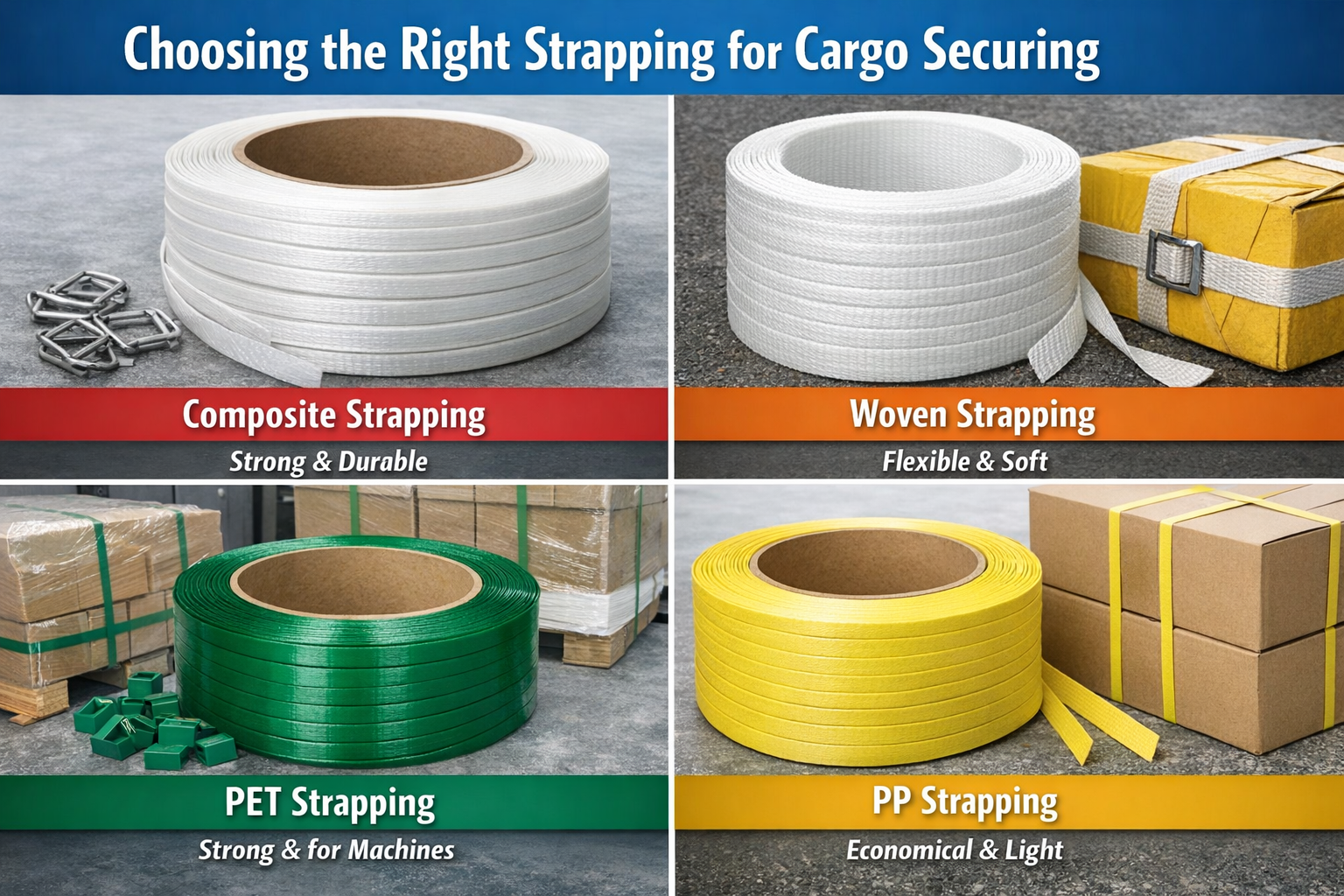
Composite and Woven Options in Relation to PET
Composite and woven strapping serve niche applications but lack the mechanical uniformity of PET in automated lines.
14. Key Criteria for Supplier Evaluation
Production Technology and Consistency Control
Suppliers with advanced extrusion lines and real-time monitoring deliver superior dimensional stability.
Lead Time Reliability and Inventory Planning
Stable lead times ensure procurement teams maintain efficient inventory without risking shortages.
Certifications, Audits, and Quality Assurance Systems
Robust QA frameworks minimize supply disruptions and strengthen long-term supplier partnerships.
15. Future Trends in PET Strapping Technology
15. Future Trends in PET Strapping Technology
Next-generation formulations promise greater strength-to-weight ratios and improved resilience.
Automation-Ready Strapping Innovations
Manufacturers are developing straps optimized for high-velocity automated tools and robotic packaging lines.
Smart Packaging Integration and Tracking Possibilities
Emerging technologies may integrate traceability markers directly into strapping materials.
16. Case Studies and Real-World Efficiency Gains
Reduced Transport Damage for High-Value Goods
Brands adopting PET strapping report fewer breakages, leading to higher customer satisfaction and fewer claims.
Cost-Down Procurement Improvements
Switching from steel to PET often results in significant cost savings due to easier handling and lower material expenses.
Enhanced Sustainability Metrics for Global Brands
PET adoption contributes to measurable reductions in CO₂ intensity across packaging operations.
17. Conclusion
Why PET Strapping Continues to Lead Global Supply Efficiency
PET combines mechanical resilience, safety advantages, and long-term stability, making it the most efficient material for global load-securing.
Strategic Benefits for Procurement Professionals
Its predictable performance reduces risk, simplifies multi-region sourcing, and empowers unified packaging standards.
How Optimized Strapping Strengthens Overall Logistics Performance
By enhancing load integrity, reducing failures, and supporting automation, PET strapping delivers substantial improvements across the entire logistics chain.
FAQs regarding polyester composite strapping
1. What is polyester PET strapping used for in industrial packaging?
It is used to secure palletized goods, heavy materials, and export shipments by providing high tensile strength, controlled elongation, and long-term tension retention during transport.
2. How does PET strapping compare to steel strapping?
PET offers high strength with added elasticity, eliminating sharp edges, corrosion risks, and recoil hazards associated with steel. It is often preferred for dynamic loads and long-distance shipments.
3. Why is PET strapping popular among global procurement teams?
Procurement professionals favor PET for its predictable performance, consistent quality across suppliers, long-term cost efficiency, and compatibility with automated strapping equipment.
4. Does PET strapping maintain tension over long transport durations?
Yes. PET strapping is specifically engineered for superior tension retention, resisting relaxation even during long-haul ocean, rail, and road transportation.
5. Is PET strapping suitable for heavy-duty applications?
Absolutely. High-strength PET straps can secure materials like timber, metals, bricks, and engineered stone, providing load stability comparable to certain steel applications.
6. Can PET strapping be used in automated packaging systems?
Yes. Its uniform thickness, smooth surface, and consistent coil quality make it ideal for automated or semi-automated wrapping and tensioning machines.
7. Is polyester PET strapping recyclable?
PET is widely recyclable and contributes to corporate sustainability targets, making it a preferred choice for brands prioritizing circular packaging initiatives.
8. How does PET perform in humid or outdoor environments?
PET is resistant to moisture, UV exposure, and temperature fluctuations. It does not rust or degrade, making it reliable for export shipments and outdoor storage.
9. What sizes and strengths are available?
PET strapping comes in various widths (commonly 9–32 mm), thicknesses, tensile strengths, and elongation profiles. OEM/ODM manufacturers can customize specifications for brand requirements.
10. What should be considered when choosing a PET strapping supplier?
Key factors include production technology, quality consistency, certifications (such as ISO standards), lead-time reliability, documentation transparency, and global supply capability.
Related Posts

Top 5 Common Mistakes in Cargo Securing and How to Avoid Them

Export Packaging Case Study: Using Composite Strapping Efficiently
