 Skip to content
Table of Contents
Categories

Jessie

1. Introduction to Polyester Woven Lashing
1.1 Why modern supply chains demand stronger cargo security
Today’s global supply chains are highly accelerated, with cargo moving through complex, multimodal routes that impose relentless stress on packaging systems. As brands expand into new markets, the variance in transport conditions increases dramatically, magnifying the need for consistently reliable cargo stabilization. Polyester woven lashing emerges as a pragmatic solution that adapts to these unpredictable logistics conditions with remarkable resilience.
1.2 Key risk factors brands face during global transit
Cargo is routinely exposed to shock, vibration, compression and high-impact forces across ocean, road and rail channels. Temperature fluctuations, humidity spikes and uneven loading surfaces further amplify the likelihood of product shifting or deformation. These factors collectively threaten product integrity, brand reputation and the financial stability of high-volume shipments.
1.3 How polyester woven lashing offers fast, scalable protection
Woven lashing introduces a lightweight yet high-strength mechanism that can be deployed rapidly across varying load configurations. Its adaptive tensioning properties allow procurement teams to secure everything from fragile goods to industrial equipment with minimal complexity. As a scalable strapping solution, it reinforces cargo security without requiring specialized tools or lengthy setup time.
2. What Polyester Woven Lashing Is
2.1 Definition and core material characteristics
Polyester woven lashing is a high-tenacity strap engineered from interlaced polyester fibers designed to resist stretching and tearing. The material’s synthetic composition ensures low moisture absorption and excellent dimensional stability. This combination results in a durable, flexible strap that maintains strength in demanding environmental conditions.
2.2 Differences from composite and steel strapping
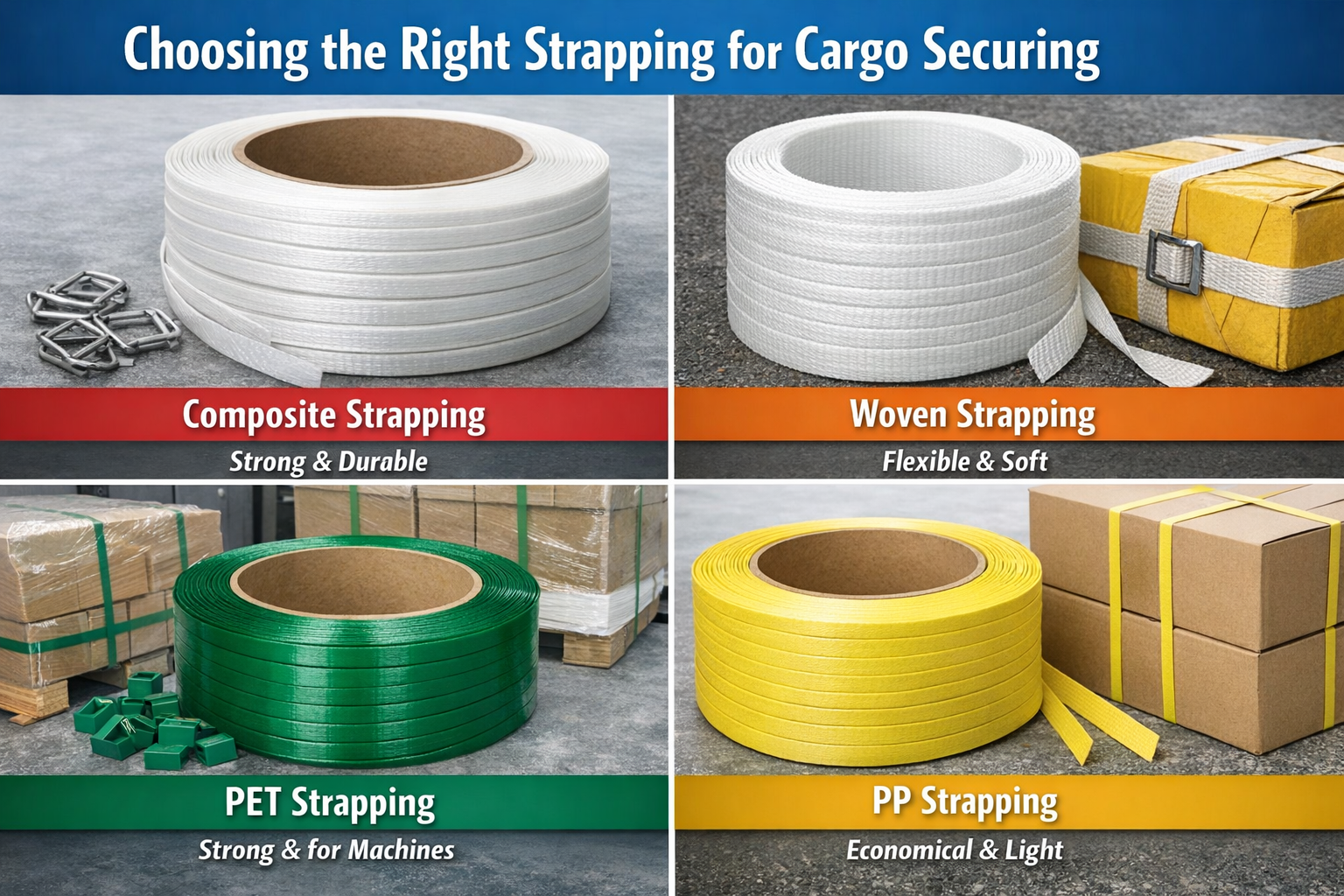
Composite strapping relies on a protective coating that provides rigidity, while woven lashing achieves strength through the interwoven construction of its fibers. Steel strapping offers extreme tensile strength but introduces risks such as sharp edges, corrosion and heavy tool demands. Woven lashing strikes a balanced compromise, offering substantial load retention while eliminating most safety and handling drawbacks.
2.3 Why woven structure enhances durability
The woven architecture distributes force evenly across the strap, preventing localized tearing under sudden load shifts. This structural flexibility allows it to absorb dynamic motions encountered during transport without permanent deformation. As a result, woven lashing maintains operational integrity even after repeated tensioning cycles.
3. How Polyester Woven Lashing Reduces Cargo Risk
3.1 Impact on shock absorption during long-haul transport
The elasticity properties within the woven fibers enable controlled elongation that cushions cargo from harsh vibrations. This shock absorption reduces micro-movements that often trigger cumulative damage in long-duration routes. It ensures loads remain uniformly anchored, even when transport conditions become erratic.
3.2 Stability improvements for irregular or heavy loads
Woven lashing conforms naturally to uneven surfaces, creating a friction-friendly interface that enhances load stability. Its ability to distribute tension along all contact points allows it to secure bulky, asymmetrical or machinery-grade cargo effectively. This holds particular relevance for procurement teams managing diverse product categories.
3.3 Resistance to weather, friction and dynamic forces
Polyester fibers resist UV exposure, moisture absorption and abrasions that commonly degrade inferior lashing materials. The strap retains its tension and strength profile even when subjected to high humidity or fluctuating temperatures. These attributes make it a dependable solution for cross-climate shipments.
4. Why Procurement Teams Choose Woven Lashing
4.1 Predictable performance for standardized packaging plans
Procurement professionals rely on materials that deliver repeatable, data-backed performance across different shipping environments. Woven lashing offers highly consistent breaking strengths and elongation characteristics, simplifying packaging standardization. This predictability drives better forecasting and reduces variability in logistics planning.
4.2 Lower claim rates and fewer transit interruptions
When cargo remains firmly stabilized, the probability of damage or loss declines significantly. This reduction directly translates into fewer insurance claims, fewer customer disputes and smoother downstream operations. Over time, these benefits support stronger supply-chain assurance for high-volume brands.
4.3 Global availability with dependable OEM supply
OEM manufacturers ensure reliable production capacity, consistent quality and scalable availability for international procurement networks. Buyers gain access to standardized SKUs that match their global operational needs. This continuity is crucial for brands shipping large volumes through multiple regional hubs.
5. Manufacturing Process Behind Quality Lashing
5.1 Yarn extrusion and high-tenacity fiber creation
The manufacturing process begins with extruding polyester pellets into robust, continuous fibers engineered for durability. These fibers undergo drawing processes that align their molecular structure, significantly strengthening their tensile performance. This stage sets the foundation for the strap’s high load-bearing capabilities.
5.2 Woven engineering for strength-to-weight optimization
Fibers are woven in patterns designed to reinforce longitudinal strength while maintaining flexibility. The weaving process enhances resistance to splitting and elongation under tension. The resulting structure maximizes load capacity without increasing weight.
5.3 Final finishing, coating and quality control steps
Lashing undergoes specialized finishing treatments that improve abrasion resistance and protect against environmental degradation. Each batch passes through stringent mechanical tests to verify breaking strength and elongation limits. These quality measures ensure dependable performance for every shipment.
6. Key Performance Metrics to Evaluate
6.1 Breaking strength and linear load capacity
Breaking strength indicates how much force the strap can withstand before failing, serving as a primary selection criterion. Linear load capacity ensures the lashing can endure sustained tension across long distances. Together, these metrics determine suitability for various cargo types.
6.2 Elongation rates and tension retention
Proper elongation enables controlled flexibility that prevents shock damage during transit. Tension retention ensures the strap maintains stability throughout the shipment journey. Both attributes contribute to overall safety and cargo preservation.
6.3 Compatibility with buckles and system components
Lashing must integrate seamlessly with buckles designed to lock and hold tension reliably. Proper compatibility ensures full performance potential is reached and prevents slippage. Procurement teams should evaluate buckle materials, coatings and locking mechanisms.
7. Comparing Woven Lashing to Alternative Solutions
7.1 Woven vs. composite strapping
Composite strapping offers a smoother exterior but can be more rigid and less forgiving under dynamic load conditions. Woven lashing adapts better to irregular surfaces due to its flexible fiber pattern. This adaptability makes it particularly advantageous in demanding logistics lanes.
7.2 Woven vs. steel banding
Steel banding provides exceptional strength but comes with higher safety risks, greater weight and increased handling requirements. Woven lashing delivers strong performance without sharp edges or corrosion concerns. It also eliminates the need for heavy-duty tensioning equipment.
7.3 Cost-to-performance evaluation for each option
Long-term cost efficiency arises from reduced tooling, lower shipping claims and streamlined handling processes. Woven lashing delivers competitive strength at a fraction of the operational complexity of steel. Its balance of performance and convenience offers compelling value for procurement teams.
8. Safety Advantages for Global Shipments
8.1 Non-sparking, injury-reducing attributes
Polyester materials do not produce dangerous sparks or sharp metal fragments. This substantially reduces workplace hazards during application and removal. The softer edges also minimize the risk of operator injuries.
8.2 Safe tightening without heavy tools
Woven lashing can be tensioned using lightweight manual tools, increasing ergonomics and operational convenience. This simplicity reduces training demands and accelerates application time. It supports safer workflows in busy warehouse environments.
8.3 Compliance benefits for international freight
Many international freight standards recognize woven lashing as a safe alternative to steel. Its compliance-friendly properties simplify exports to regions with strict cargo security protocols. For brands shipping globally, this alignment reduces administrative burdens.
9. Role of Woven Lashing in Containerized Shipping
9.1 Securing palletized and mixed-product loads
Woven lashing adapts effectively to multi-pallet and mixed-category shipments typical in container logistics. It stabilizes loads independently of pallet shape or product distribution. This helps maintain structural cohesion during transit.
9.2 Preventing sway and movement during ocean transit
Ocean movement generates significant lateral forces that can destabilize unsecured cargo. Woven lashing counters this by holding loads firmly in place, preventing tipping or shifting. This is particularly crucial in long-duration sea routes.
9.3 Minimizing damage in high-humidity environments
Polyester fibers resist moisture absorption, making them ideal for humid marine climates. The strap retains its tension without sagging, even after prolonged exposure. This stability helps prevent mold, collapse or compression damage.
10. Lashing in E-commerce and High-Turnover Distribution
10.1 Fast application for rapid dispatch cycles
E-commerce operations prioritize speed, requiring packaging materials that can be applied quickly. Woven lashing’s simple tensioning process supports tight turnaround times. This efficiency enables faster fulfillment during peak seasons.
10.2 Versatility for multi-size package stabilization
Warehouses handle products of varying shapes and dimensions that require adaptive securing solutions. Woven lashing conforms easily to diverse packaging forms without specialized equipment. This makes it particularly useful in dynamic sorting environments.
10.3 Reducing repacking during last-mile disruptions
Last-mile transit often involves sudden shocks or road irregularities that cause load shifts. Woven lashing preserves internal stability, reducing the need for repacking upon delivery. This improves operational continuity and customer satisfaction.
11. Customization Options for OEM and ODM Buyers
11.1 Private-label packaging and color coding
Brands can customize lashing with color-coded identifiers and private-label designs that support brand visibility. Such customization enhances operational organization and internal categorization. It also aligns packaging aesthetics with brand guidelines.
11.2 Tailored widths, strengths and roll lengths
Different industries require varying tensile strengths and strap dimensions. OEM manufacturers provide an array of options tailored to specific cargo requirements. This flexibility ensures optimal performance across diverse applications.
11.3 Co-branded safety instructions and printing
Printed instructions or brand marks add clarity for end users and reinforce professional visibility. These printed labels ensure proper application in third-party logistics scenarios. They also reduce misuse and training errors.
12. How to Select the Right Lashing for Your Brand
12.1 Understanding load profiles and transport modes
Effective selection begins with assessing cargo weight, density and fragility. Transport mode—whether ocean, rail or truck—also influences required load retention. This evaluation ensures the correct performance grade is chosen
12.2 Matching strength rating to cargo requirements
Procurement teams should align breaking strength and linear load capacity with expected forces during transit. Over-specifying inflates costs, while under-specifying jeopardizes cargo integrity. Accurate assessment ensures balanced protection and efficiency.
12.3 Choosing the correct buckle system
Buckles play a critical role in tension retention and secure closure. Selecting compatible materials and locking mechanisms protects the system from slippage. Proper pairing yields maximum lashing performance.
13. Best Practices for Application
13.1 Proper tensioning and threading techniques
Correct threading through the buckle ensures secure tensioning that prevents load movement. Operators should apply even force to avoid overstressing certain strap sections. Consistency improves long-term reliability.
13.2 Securing cross patterns for maximum stability
Cross patterns distribute tension across multiple axes, enhancing overall load stability. This method is particularly beneficial for heavy or irregular cargo profiles. It minimizes lateral and forward motion during transit.
13.3 Inspection tips before shipment release
Before dispatch, operators should inspect for fraying, improper threading or insufficient tension. These quick checks significantly reduce the risk of in-transit failure. Routine inspection strengthens quality control processes.
14. Cost Efficiency and Procurement Impact
14.1 Lower tooling and maintenance expenses
Woven lashing requires minimal equipment, reducing capital expenditure for tensioning tools. Maintenance costs remain low due to the strap’s resilience and simplified operation. This efficiency directly benefits procurement budgets.
14.2 Reducing product damage and claims
Enhanced stability leads to fewer damaged goods and reduced returns. These improvements impact the bottom line positively by avoiding claim-related losses. Over time, the financial advantages become substantial.
14.3 Supply-chain simplification with standardized SKUs
Standardized lashing solutions reduce complexity across warehousing and distribution networks. This consolidation improves forecasting accuracy and operational efficiency. It also enhances procurement simplicity for multinational operations.
15. Sustainability Considerations
15.1 Recyclability of polyester materials
Polyester offers recyclability advantages that align with modern sustainability objectives. After use, materials can be reprocessed into new industrial products. This supports circular-economy initiatives across global supply chains.
15.2 Reducing waste versus disposable alternatives
Woven lashing generates less waste than many single-use securing materials. Its durability ensures longer service life, reducing environmental footprint. This makes it a more responsible choice for eco-conscious brands.
15.3 Responsible sourcing from certified manufacturers
OEM partners that follow certified environmental practices contribute to transparent supply chains. Responsible sourcing enhances corporate ESG metrics and strengthens stakeholder trust. Brands benefit from aligning with reputable manufacturing partners.
16. Case Examples of Reduced Cargo Risk
16.1 Heavy machinery shipments with zero movement
Machinery shipments often experience intense transit forces that test securing systems. Woven lashing maintained load stability even during multi-modal relocation across continents. This resulted in zero in-transit damage reports.
16.2 FMCG pallet stabilization in high-volume lanes
Fast-moving consumer goods require resilient packaging to maintain throughput efficiency. Woven lashing stabilized pallet loads amid rapid warehouse cycling and high-speed transport routes. This improved overall supply-chain continuity.
16.3 Cross-border shipments with reduced claim rates
International shipments often encounter unpredictable handling conditions. Brands using woven lashing documented significant reductions in cargo claims and disputes. This strengthened customer relationships and operational dependability.
17. Final Takeaways for Brand Procurement Teams
17.1 Strategic value of woven lashing in risk mitigation
Woven lashing delivers essential cargo security that directly addresses modern logistics challenges. Its strength, adaptability and predictable performance support strategic packaging initiatives. This makes it a vital component of comprehensive risk management.
17.2 Long-term reliability from OEM/ODM partners
Reliable manufacturing partners ensure consistent product quality and on-time supply. Their customization capabilities empower brands to optimize packaging standards. This long-term reliability contributes to improved operational resilience.
17.3 How fast adoption improves shipment consistency
By integrating woven lashing into existing processes, brands achieve immediate improvements in cargo stability. This rapid enhancement reduces disruptions and accelerates supply-chain performance. As adoption grows, shipment consistency becomes a measurable competitive advantage.
Reference
ABC
Related Posts

Top 5 Common Mistakes in Cargo Securing and How to Avoid Them

Export Packaging Case Study: Using Composite Strapping Efficiently
