 Skip to content
Table of Contents
Categories
How to Choose the Right Strapping for Cargo Securing: Composite, Woven, PET or PP?

Jessie

1. Introduction
Choosing the right strapping material is an important part of safe cargo securing and cost control. Different strapping types perform differently in strength, flexibility, elongation, shock absorption, and application method. If the wrong material is selected, it may lead to cargo movement, damaged goods, lower packing efficiency, and higher overall transport risk. For importers, distributors, and end users, understanding these differences can help improve packaging decisions and reduce unnecessary losses during shipping.
Why Strapping Selection Matters
Strapping is not only used to bundle products together, but also to stabilize cargo during storage and transportation. In domestic delivery and international shipping, cargo is often exposed to vibration, compression, impact, and shifting forces. A suitable strapping solution helps maintain load integrity and supports safer handling throughout the supply chain. That is why buyers should evaluate strapping not just by price, but also by performance in real transport conditions.
Composite Strapping
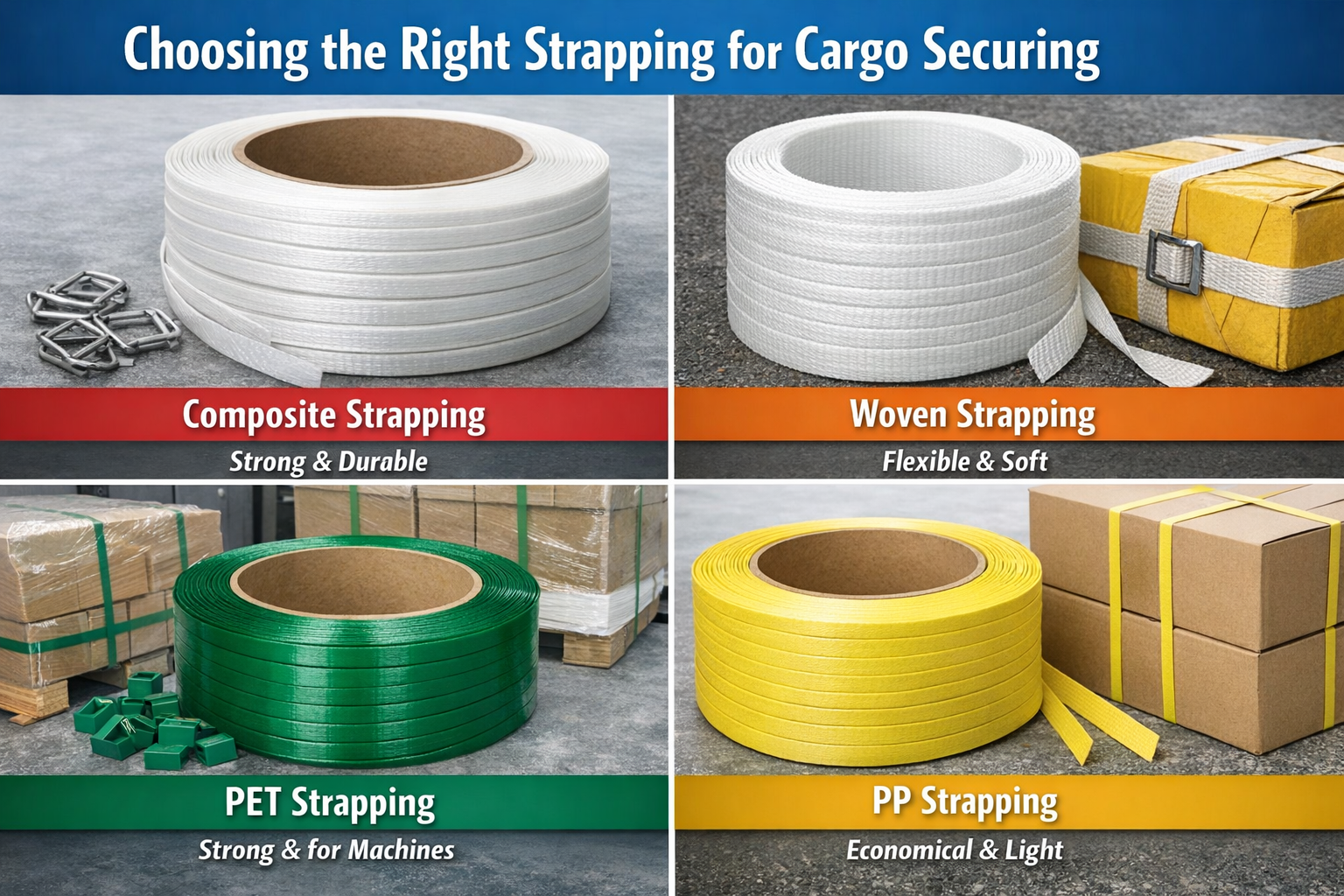
Composite strapping is made from high-tenacity polyester yarns coated with a polymer layer, giving it both strength and durability. It is widely used for heavy-duty cargo securing because it offers high tensile strength and excellent shock absorption during transport. Compared with steel strapping, composite strapping is safer to handle, does not rust, and is less likely to damage product surfaces. It is commonly used together with wire buckles for machinery, timber, steel products, palletized cargo, and export packaging. For customers who need strong and reliable manual securing, composite strapping is often one of the best choices.
Main Advantages of Composite Strapping
Composite strapping offers high tensile strength and excellent resistance to transport shock. It is safer than steel strapping because it has no sharp edges and is easier to handle. It is also suitable for export cargo that requires stable and reliable securing.
Typical Applications of Composite Strapping
Selecting securing materials based on availability or cost rather than performance requirements is a frequent error. Using products not rated for the load, environment, or transport mode significantly compromises cargo stability. Incompatible combinations of straps, buckles, and accessories further increase failure risk.
Typical Problems Caused by Material Mismatch
This type of strapping is commonly used for timber, machinery, steel products, and palletized cargo. It is also widely used in export packaging and container load securing. Buyers often choose it when they need a strong manual strapping solution.
Woven Strapping
Woven strapping is produced from woven polyester fibers and is known for its flexibility and soft surface. It is easier to handle than many rigid strapping materials, especially when goods have irregular shapes or fragile outer packaging. Woven strapping also provides good tension retention and can absorb movement during transport, which helps reduce the risk of load instability. It is often used in export packaging, logistics, fragile cargo securing, and applications where manual handling is preferred. For buyers who want a balance of strength, flexibility, and safer application, woven strapping is a very practical option.
Main Advantages of Woven Strapping
Woven strapping is soft, flexible, and easy to apply manually. It works well for goods with sensitive surfaces or irregular shapes. It also offers stable tension retention during transport.
Typical Applications of Woven Strapping
Woven strapping is often used in logistics, export packaging, and fragile cargo securing. It is also suitable for loads that require flexible but dependable restraint. Many importers and distributors prefer it for manual packing operations.
PET Strapping
PET strapping is a strong plastic strapping material commonly used in palletizing and machine-operated packaging lines. It has high tensile strength and good elongation recovery, which makes it suitable for medium to heavy loads in industrial packaging. PET strapping is often used as an alternative to steel strapping in certain applications because it is lighter, easier to handle, and more economical in many cases. It is especially common in industries such as paper, bricks, cotton, glass, and fibers where stable pallet unitization is important. For customers using automatic or semi-automatic packaging systems, PET strapping is usually a very efficient solution.
Main Advantages of PET Strapping
PET strapping combines strength with good elongation recovery. It is suitable for machine use and supports efficient pallet packaging. It is often chosen as a cost-effective alternative to steel strapping.
Typical Applications of PET Strapping
PET strapping is widely used in the paper, glass, brick, cotton, and fiber industries. It is especially suitable for palletized cargo and automated production lines. Customers often select it for medium to heavy-duty industrial packaging.
PP Strapping
PP strapping is one of the most economical choices for light-duty bundling and general packaging use. It is lightweight, easy to operate, and widely used in carton packing, light pallet securing, and routine warehouse packaging. PP strapping is suitable for automatic, semi-automatic, and manual applications depending on the product specification. Although it does not offer the same strength as composite, woven, or PET strapping, it performs well for lighter loads and cost-sensitive applications. For businesses looking for simple and affordable packaging materials, PP strapping remains a popular choice.
Main Advantages of PP Strapping
PP strapping is lightweight, economical, and easy to use. It is ideal for daily packaging tasks and lighter bundling needs. It is also widely compatible with different types of packing machines.
Typical Applications of PP Strapping
PP strapping is often used for cartons, light pallet loads, and general warehouse packaging. It is suitable for routine bundling where high tensile strength is not required. It remains a practical option for cost-sensitive packaging users.
Key Factors to Consider Before Choosing Strapping
Before selecting strapping, buyers should first consider the weight and stability requirements of the cargo. Heavy products usually require stronger materials such as composite strapping, woven strapping, or PET strapping, while lighter cartons may only need PP strapping. It is also important to think about transport conditions, including long-distance shipping, vibration, and repeated handling. In addition, the packing method matters, because manual applications and machine applications often require different strap types. Budget is another factor, but it should always be considered together with performance, labor efficiency, and cargo protection.
Cargo Weight and Load Stability
The size and weight of the cargo directly affect the required strap strength. Heavier or unstable loads usually need stronger and more durable materials. Lightweight goods can often be secured with more economical options.
Transport Conditions
Long-distance transport can expose cargo to shock, vibration, and movement. In these cases, strapping with better shock absorption and tension retention is preferred. This is especially important for export shipments and container transport.
Packing Method and Budget
Manual packing and machine packing may require different strapping types. Buyers should also compare labor efficiency, tool compatibility, and total packaging cost. The cheapest material is not always the most economical choice in practice.
Which Strapping Is Best for Different Applications
There is no single strapping material that is ideal for every type of cargo. Composite strapping is often preferred for heavy-duty securing and export shipments where shock absorption is important. Woven strapping is suitable for flexible and safer bundling, especially for irregular or fragile loads. PET strapping works very well in palletized industrial packaging and machine use, while PP strapping is a practical choice for light-duty and economical packaging tasks. The most suitable option depends on your cargo type, handling process, and transport environment.
Conclusion
Choosing the right strapping can improve cargo safety, reduce damage risk, and support more efficient packaging operations. Buyers should compare materials not only by price, but also by strength, flexibility, application method, and transport performance. Composite, woven, PET, and PP strapping each have their own advantages, and the best choice depends on the actual packaging need. At Mulan, we supply a full range of cargo securing and packaging materials to help customers find the right solution for different applications. Whether you are a distributor, importer, or end user, selecting the correct strapping can make a real difference in both safety and cost.
Call to Action
Mulan supplies composite strapping, woven strapping, PET strapping, PP strapping, wire buckles, metal buckles, dunnage airbags, edge protectors, and related packaging tools. We support customers with stable quality, flexible quantities, and competitive pricing for different cargo securing requirements. If you are looking for the right strapping solution for your products, our team is ready to help with recommendations, specifications, and samples.
Related Posts
Top 5 Common Mistakes in Cargo Securing and How to Avoid Them

Export Packaging Case Study: Using Composite Strapping Efficiently
