 Skip to content
Table of Contents
Categories

Jessie
Composite Strapping vs. Polyester Woven Lashing: A Practical Buyer’s Guide
Introduction: Why the Right Cargo Securing Matters
During transportation, cargo is exposed to vibration, shifting forces, humidity, and long transit times — especially in export containers and long-distance shipping. Selecting the correct load securing material is not just a cost decision; it directly affects cargo safety, damage claims, and operational efficiency.
For procurement managers and packaging engineers, the challenge is choosing a securing system that balances strength, safety, handling efficiency, and cost. Among modern solutions, composite strapping and polyester woven lashing are widely used as reliable alternatives to traditional steel strapping.
This guide explains the differences between composite straps and woven lashing from a buyer and engineering perspective, helping you select the most suitable solution based on cargo behavior and transport conditions.
What Is Composite Strapping?
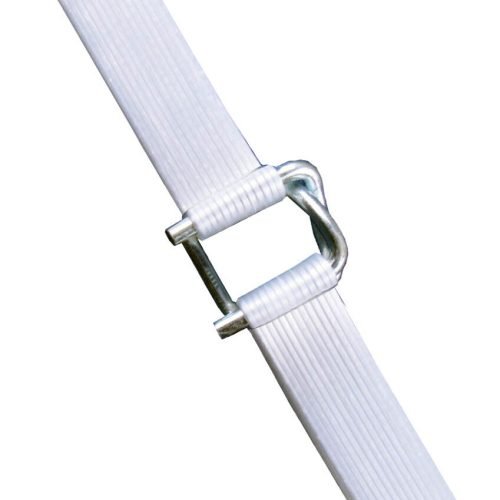
Composite strapping is manufactured from high-tensile polyester fibres that run longitudinally and are encapsulated in a polypropylene (PP) coating. This construction creates a strap that combines strength, controlled elongation, and excellent abrasion resistance.
The PP coating protects the internal fibres from moisture, UV exposure, and surface damage, while allowing the strap to absorb shock loads during transit. This makes composite strapping particularly suitable for dynamic loads where movement and vibration are expected.
Composite straps are typically used together with galvanized wire buckles and manual or pneumatic tensioners to form a complete strapping system.
Key Benefits of Composite Strapping
High tensile strength suitable for heavy loads
Excellent shock absorption due to controlled elongation
Abrasion and UV resistance from the PP coating
Lightweight and safe handling compared to steel straps
Good tension retention during long-distance transport
Typical Applications
Palletized goods and unitized loads
Steel products and metal bundles
Building materials
Maritime and export shipments requiring vibration resistance
What Is Polyester Woven Lashing?
Polyester woven lashing is produced from high-tenacity polyester yarns woven into a dense, flexible belt. Unlike composite strapping, woven lashing has very low elongation (typically below 10%), which allows it to remain extremely tight once tensioned.
Woven lashing is commonly designed as a one-way cargo securing system, especially for use inside shipping containers or on flat racks. Its high system strength makes it an effective replacement for steel lashing in many export applications.
It is compatible with phosphate-coated or galvanized buckles, which are treated for corrosion resistance in marine and outdoor environments.
Key Benefits of Woven Lashing
Very high system strength for heavy and static loads
Low elongation for maximum load stability
Moisture and corrosion resistance
Flexible and splice-free construction
Safer alternative to steel lashing
Typical Applications
Securing machinery inside containers
Flat-rack and breakbulk cargo
Heavy equipment and oversized loads
Export shipments requiring rigid load restraint

Composite Strap vs. Polyester Woven Lashing: Key Differences
While both composite strapping and polyester woven lashing are widely used for cargo securing, they are designed to perform differently depending on load behavior and transport conditions.
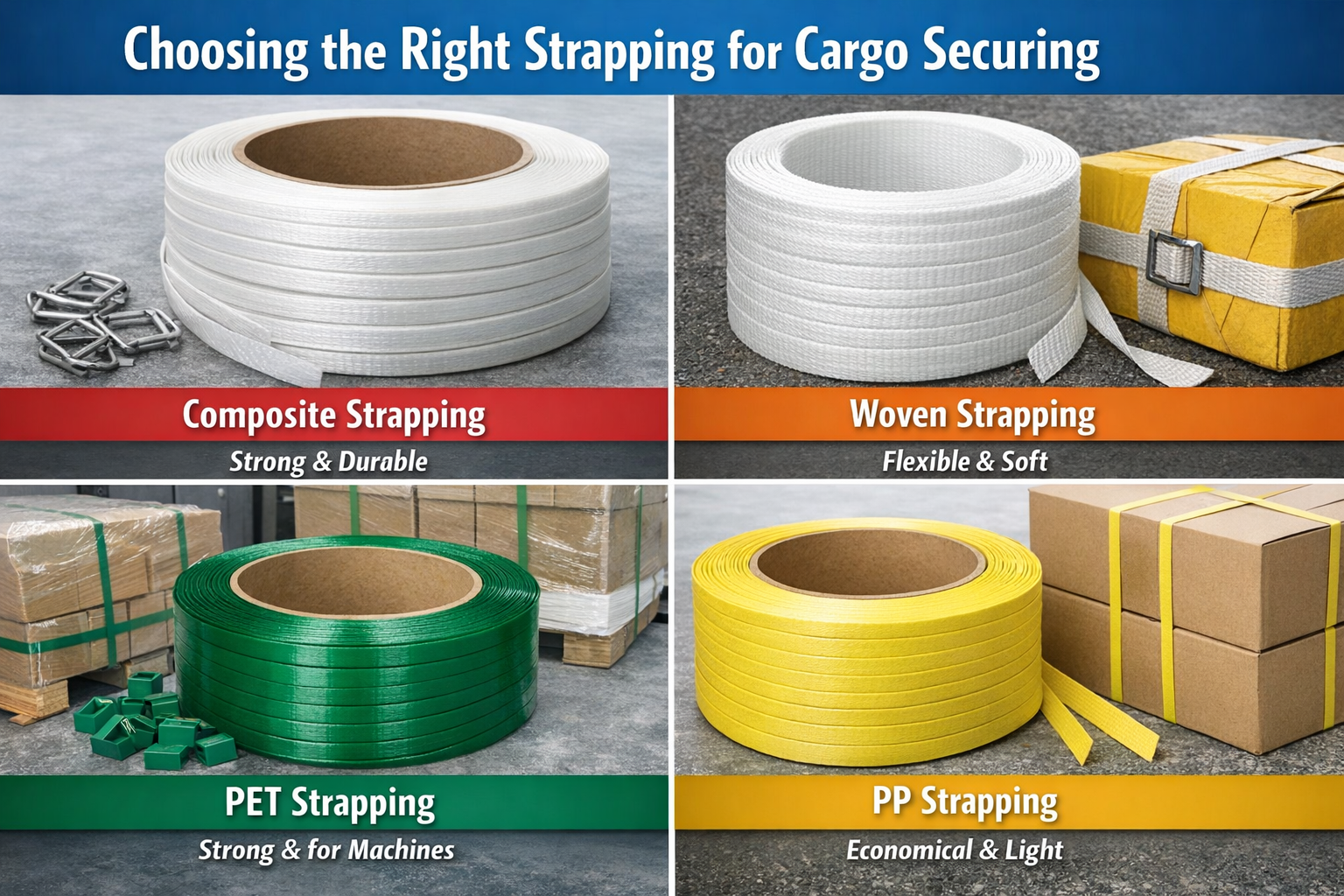
Composite strapping offers medium elongation, which allows it to absorb shocks and vibrations during transit. This makes it particularly suitable for dynamic loads, such as palletized goods or bundled products that may shift during transportation. Its excellent shock absorption helps maintain tension and reduce the risk of load damage. Composite strapping can be reused in some applications, although reusability is generally limited. Compared to steel strapping, it serves as a partial alternative, especially where corrosion resistance and safer handling are required.
In contrast, polyester woven lashing features very low elongation (typically below 10%), allowing it to remain extremely tight once tensioned. This characteristic makes it ideal for static and heavy loads, where minimal movement is acceptable or expected. Woven lashing is most commonly used for securing cargo inside containers or on flat racks, particularly for machinery and oversized goods. It is typically designed as a single-use securing solution and is widely regarded as a strong replacement for steel lashing, offering high system strength without the risks associated with steel straps.
Industry Applications
Both systems are widely used across industries where cargo security is critical:
Steel & Metal Products – coils, pipes, profiles
Machinery & Equipment – industrial machines, generators
Construction Materials – stone, panels, timber
Logistics & Export Packaging – containerized and breakbulk cargo
Choosing between composite strapping and woven lashing depends on cargo weight, movement risk, and transport conditions.
Buckles, Tools & System Strength
An effective cargo securing solution depends not only on the strap itself but on the entire system:
Wire Buckles: Commonly used with composite strapping for optimal grip
Phosphate Buckles: Preferred for woven lashing in container environments
Manual or Pneumatic Tensioners: Ensure correct and consistent tension
Buyers should focus on system strength rather than linear strap strength alone. Proper matching of strap, buckle, and tool is essential for safe load securing.
Quality Standards & Testing
Reliable manufacturers apply strict quality control throughout production, including:
Tensile and system strength testing
Elongation and abrasion resistance checks
Moisture and environmental performance testing
Batch traceability and internal inspections
Consistent quality ensures predictable performance during transport and compliance with international cargo securing practices.
How to Choose the Right Solution
When selecting between composite strapping and woven lashing, consider:
Cargo weight and dimensions
Transport mode (road, sea, rail)
Dynamic vs. static load behavior
One-way or reusable requirement
Container, pallet, or flat-rack use
Working with an experienced manufacturer allows these factors to be evaluated and matched with the correct securing system.
Buyer FAQs
1.Is composite strapping stronger than polyester woven lashing?
Not necessarily. Composite strapping offers excellent shock absorption and dynamic load control, while woven lashing generally provides higher system strength with lower elongation. The correct choice depends on cargo behavior rather than strap strength alone.
2.Can composite strapping replace steel strapping?
In many applications, yes. Composite strapping is widely used as a safer and corrosion-free alternative to steel strapping, especially for palletized and export cargo where shock absorption is required.
3.Is woven lashing suitable for maritime transport?
Yes. Polyester woven lashing is commonly used inside shipping containers and on flat racks due to its low elongation, high tensile strength, and resistance to moisture and corrosion.
4.Should buyers focus on linear strength or system strength?
System strength is more important. A properly matched strap, buckle, and tensioning tool ensure reliable cargo securing performance.
Conclusion
Composite strapping and polyester woven lashing both provide modern, reliable solutions for cargo securing. Composite straps excel in shock absorption and flexibility, while woven lashing offers maximum stability for heavy, static loads.
For international shipments, container transport, and heavy industrial cargo, selecting the correct system helps reduce damage risk, improve safety, and lower long-term logistics costs. Working with an experienced OEM/ODM manufacturer allows securing solutions to be customized according to cargo type, transport mode, and regulatory requirements.
Related Posts
Top 5 Common Mistakes in Cargo Securing and How to Avoid Them

Export Packaging Case Study: Using Composite Strapping Efficiently
